The reel we set out to copy cuts thirty times in six seconds. It looks like a shoot — several angles, a crew, a day of footage.
It is two shots.

That is the finding that makes faceless reels affordable, and it is not obvious from watching one. Everything below comes from one recorded session on 30 July 2026: two reference reels measured, one rebuilt with a character we own, and a ledger of what each part cost. The session is on tape, arguments and failures included:
The session this article is written from6:43 · 30.07.2026
Copy the format, not the video. The teardown is free, the assembly is free, and the only thing you approve an estimate for is the seconds in between. Start free — or see what a run costs first.
What the teardown actually measured
We handed the agent two reels and asked it to read them frame by frame. That analysis is free — it ran at 0 credits — and it came back with numbers rather than adjectives:
What the teardown measured0 credits
- A6 s · 30 cutsmedian 0.2 s apart2 shots
- B10 s · 47 cuts≈0.12 s apart2 shots
Five rules fell out of it:
- Two shots, not thirty. The entire edit is a ping-pong between two compositions. Cheap to make, hypnotic to watch.
- Five to eight cuts a second, locked to the beat where a beat exists.
- About six seconds, so the feed loops it three or four times before a viewer notices the loop. The view count inflates itself.
- One axis of contrast — in one reference it was temperature and place, in the other it was scale.
- Zero information. No text, no speech. Pure aesthetic hypnosis.
Thirty cuts are not thirty generations
One fact decides whether a faceless reel costs two dollars or twenty.
You do not generate thirty clips. You generate two, four seconds each, and then cut between them thirty-one times on a timeline. The cutting is file manipulation — it happens locally, and it costs 0 credits. Only the seconds you generate are paid for.
That is why the format is worth copying and not just admiring: the thing that looks like the work is free, and the thing that costs money is four seconds long.
What the seconds cost
Three lanes were offered, priced per source clip before anything ran:
Per source clip · 4 seconds2 clips needed, not 30
- takenGrok ImagineHolds a face best at this length, up to 720p — the lane we took.~7 cr≈$0.07
- offeredSeedance 1.5 ProRichest movement.~17 cr≈$0.17
- offeredSeedance 2 MiniSeveral distinct angles inside one clip.~49 cr≈$0.49
We took the cheapest one. Grok holds a face better than the others at this length, and the character had to stay recognisably himself across both shots — which he could, because he arrived as a reference sheet rather than a description.
The full estimate before the run: the sketch clip at 7.2 credits, starting frames for both shots carrying the character's face at 12 credits, a music bed, and SFX on the cuts. Roughly a quarter of a dollar of generation for a six-second piece — and, again, nothing at all for the thirty cuts.
The agent argued with the format before it spent anything
Rule five — zero information — is a real property of the reference, and it was wrong for us. Our character is positioned as an expert. A beautiful, silent flicker of his face says nothing an expert would say; it is a mood-account format wearing an authority's face.
The agent said so, in the estimate, before a credit moved:
point five is a direct conflict. A literal copy of a silent aesthetic flicker with his face will be beautiful and meaningless — that is an account-mood format, not an authority's. But the mechanism carries over perfectly if you reframe it as two states: before / after, amateur / professional, idea / execution, mock-up / production. Then the flicker works as a hook for the first three seconds and lands in a thought after it.
We took the reframe: sketch → finished product. Same rhythm, same two-shot mechanism, an argument instead of a mood.
This is the difference between copying a video and copying a format. The video is the other person's brand. The format is a machine, and a machine can carry your argument instead of theirs.
What came back, and what broke
The finished piece: 6.2 seconds, 1080×1920, 24 fps, sound on, assembled from two 4-second clips at 720×1264. Assembly: 0 credits, as quoted.
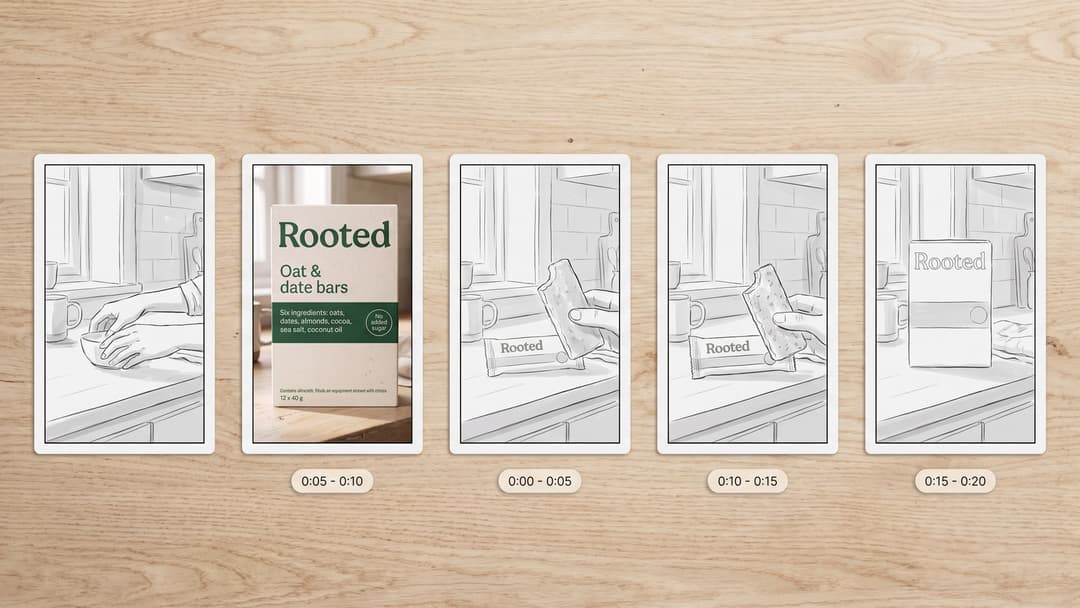
The mechanism worked, and the proof is in the timing rather than the look — 0.1 s of sketch, 0.3 s of the product wide, then at 5.9 s the sketch again but with the camera in a different place. The composition moved within the clip, which is what makes it read as a live flicker rather than two frozen frames alternating. That was the hard technical requirement, and it is what the 0.2-second cadence is cutting into.
What did not work, stated plainly because a run that only reports its successes is a brochure:
- One shot faced the wrong way. The generated second composition pointed the wrong direction, and no amount of assembly fixes a wrong camera. The choice offered was honest: assemble now for 0 credits, or regenerate that shot for ~13 credits. We assembled first — testing the mechanism with a flawed input is cheaper than arguing about it.
- The SFX did not generate. The assembly carried music only, which costs the format its best trick: in the reference, the sound lands exactly on the cut, and that hit is most of why it feels intentional.
- One extracted frame came back rotated 90°. Frame-accurate slicing did not apply a rotation flag the source carried.
- The progress readout disappears exactly when you need it. While the job ran on schedule the chat showed a stage and an ETA. The moment it overran, both were replaced by "running, taking longer than usual" — no stage, no percentage, no revised estimate. That is the point at which you have to decide whether to cancel, and cancelling burns what was already generated.
The half that pays for itself later
Two things survive the run and cost nothing to keep:
- The format becomes a preset. The whole configuration — flicker, contrast axis, 0.2-second cadence, model, sound plan, tone — is saved and appears among the templates next time. Any other character can be dropped into it.
- The reel lands in review, not in your feed. It arrives in the content hub marked needs review: watch it, approve it, and only then does it become schedulable. Approval is the publishing gate, and edits are re-quoted with a price before anything is spent again.
How to make faceless reels without filming anything
The route, in the order that works:
- Collect formats, not ideas. Save the reels that stop you. The teardown works on a link, and it is free.
- Let something measure the rhythm. Thirty cuts in six seconds is a fact about a file, not a feeling; 0.2 seconds is a number you can build to.
- Count the generations, not the cuts. Two clips, not thirty. If a plan proposes one generation per cut, the plan is wrong by an order of magnitude.
- Bring your own face — a real reference sheet. A faceless reel still needs a consistent someone, or every cut is a different person and the format collapses. The same rule holds for anything you sell: a product drawn from a description comes back with the brand misspelled.
- Reframe before you copy. Take the mechanism, refuse the parts that contradict what you are known for.
- Approve the estimate, then the result. Two gates, both cheap.
Nothing in that list requires a camera, a location, or a person willing to be on the internet. The seconds are the only thing you buy, and there are eight of them.