
Most guides to creating an AI influencer end where the trouble starts. You get a picture. It is a good picture. Then you make a second video and it is somebody else — same hair colour, different face, and nobody watching believes in either of them.
The fix is one artifact, made once, before any content exists.
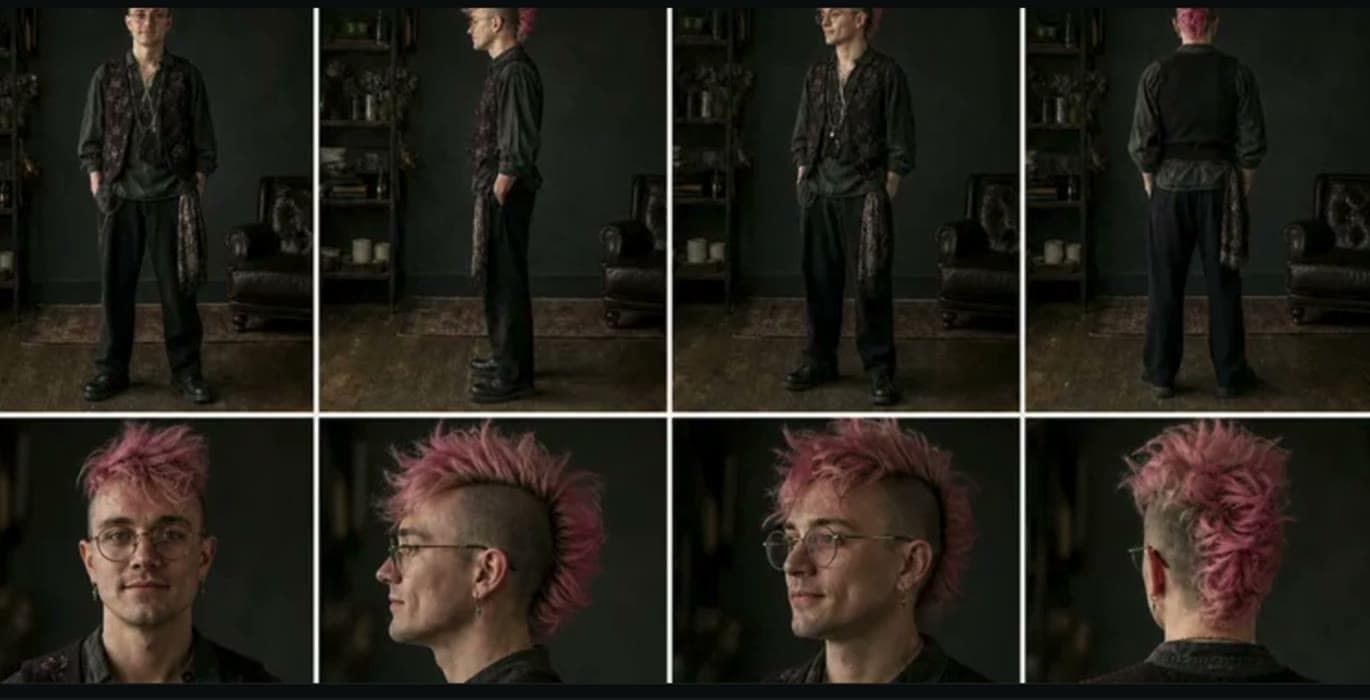
Everything below is one recorded session on 30 July 2026: four free steps of configuration, one paid generation of 12 credits (~$0.12), five images back, and a character saved to the roster 4 minutes 30 seconds after the button. The whole thing is on tape, so nothing here is a reconstruction:
The session this article is written from6:05 · 30.07.2026
Build the face once, then stop paying for it. The configuration costs nothing and the card it produces is what every later render copies. Start free — or see what a run costs first.
What an identity card actually is
It is a single image holding the same character from every angle a camera can take: full length from the front, the side, three-quarter and the back, then the head at the same four angles. Eight cells, one person.
That sheet is not a deliverable. It is a reference, and it is the input to every generation that comes after it — every reel, every still, every ad. The model is not asked to imagine your influencer each time; it is shown one.
This is the same argument our product-card teardown makes about packaging, pointed at a person instead: give it pictures, not adjectives. A face you can only describe is a face that will drift.
The four steps that cost nothing
The configurator is free, and it says so on the panel: nothing is generated until you run the card in the Agent. Four steps:
- Appearance — sex, age, ethnicity, skin tone, build, height, and then the face broken into parts: eye colour and shape, nose, lips, jawline, facial hair, hair colour and cut. There is a Random button that fills all of it, which is the fastest way to see the shape of the form.
- Character — up to three key traits, a communication style, a humour register, a voice character, the language, and the art style. Leave art style on Photorealistic or your renders come back stylised; it is a setting, not a default outcome.
- Profession — the main subject, the role, the niches. Ours was business and startups, expert / thought leader, fashion and art.
- Review — everything on one screen, and then the whole configuration is handed to the Agent as a filled-in prompt.
You can skip all four. The same character can be described to the Agent in a sentence, or built from photographs you upload — including your own, if the influencer is meant to be you. The wizard exists because "pick from these options" is faster than "describe a jawline".
One practical detail from the recording: the chat takes dictation, and the microphone reads whichever language is selected next to it. Dictating Russian with the input set to English produces a prompt nobody can use.
The one thing that costs money
Before generating anything, the Agent prices it:
Cost preview — identity card12 credits ≈ $0.12
- lineIdentity card still · 2K · realism6.0 cr
- lineRealism-engine pass6.0 cr
- option1K instead of 2KNamed beside the estimate, and declined — the card is read as a reference by every later render, not looked at once.7.2 cr
Twelve credits — about twelve cents — for the still and the realism pass together. A cheaper tier was offered and declined out loud: 1K instead of 2K is 7.2 credits, and the reason to pay the extra 4.8 is that this image is a reference other renders will read for months, not a picture anybody will look at once.
That is the economics of a recurring character: the expensive part is not the face. It is every video that comes after it.
What came back, and how long it took
The queue estimated ~6 minutes. The job reported 4m 30s.
Back came the card at the top of this page, plus a plain statement of what had been spent — 12 credits, as quoted. Two things about that moment are worth copying even if you never touch our product:
- The character is a draft until you say otherwise. It sits in the roster unsaved; answering yes, save it is what makes it real. A generation that silently commits a half-liked character to your library is a generation you will be deleting for weeks.
- If the result does not appear, ask for it. Rendering finishes before the chat catches up; "show me the generated influencer" pulls it in.
The part nobody puts in a tutorial: the brief argued back
While the render was queued, the Agent flagged something in the persona it had just been handed:
your persona line contains a contradiction — "fun teasing lighthearted tone" alongside "serious, no humor". That won't affect the face render, but it will pull scripts in two directions the moment we write copy for him.
It was right, and the timing is the point. That contradiction was assembled by clicking two chips two steps apart in a wizard — Playful on communication style, Serious on humour — and it would have survived until the first script read wrong. It cost nothing to catch, because the catch happened while a $0.12 job was still in a queue.
A configurator will let you build a person who cannot exist. Something has to read the whole sheet back to you before it becomes ten videos.
Voice is a separate step, and it should be
The card is a face. It carries no voice, and asking for one is a separate sentence in the chat: pick a voice that suits this character. A voice is selected and attached to the influencer automatically — or you record your own, upload the file, and use that instead.
Keeping them apart is deliberate. A face you like with a voice you hate is one cheap regeneration away from fixed; a bundle is not.
Where this sits when you actually create an AI influencer
The order that survives contact with real production:
- Configure for free. Four steps, or one sentence to the Agent, or your own photographs. Nothing is spent.
- Read the cost preview before it runs. Ours was 12 credits with a 7.2 alternative named beside it — an estimate that hides the cheaper option is not an estimate.
- Buy the card once, at the higher resolution. Every later render reads it.
- Save deliberately. Draft until you say yes.
- Add the voice after the face. Separately, so either can be redone alone.
- Then spend on content, where the money goes — the models, the seconds, the four-way comparison that decides which one draws your character best, and formats like the thirty-cut flicker that turn out to need two generations rather than thirty.
Everything before step 6 cost twelve cents and four and a half minutes. That is the entire setup cost of a recurring face, and it is the reason the second video still has the same person in it.